Securing Smart Home Connected Devices: A Guide for Hardware OEMs
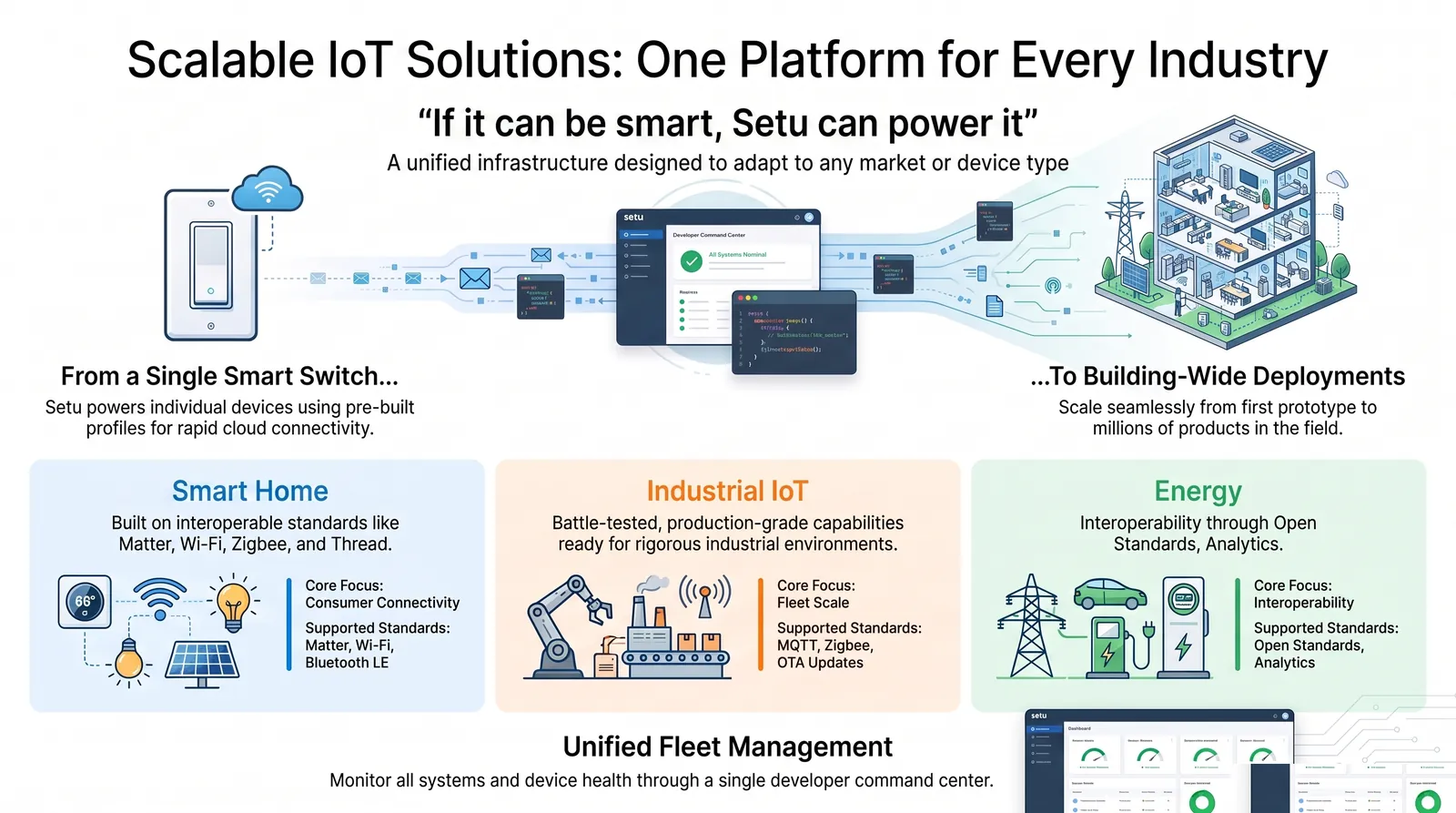
As smart appliances, connected lighting, and energy monitoring fleets enter millions of consumer homes, cybersecurity has transitioned from a checklist item to a critical design constraint.
Furthermore, data safety compliance rules (such as India's **Digital Personal Data Protection (DPDP) Act, 2023**) impose severe penalties for security breaches that compromise consumer data. For hardware OEMs, securing the device lifecycle—from factory floor provisioning to runtime user activity—is essential.
The Three Pillars of Device-to-Cloud Security
A secure IoT network is only as strong as its weakest link. Implementing security requires addressing three core domains:
1. Mutual TLS (mTLS) for Device Authentication
Traditional username/password combinations or static API tokens are highly vulnerable to leakage. Security best practice requires **mTLS (mutual TLS)**, where both the cloud server and the physical device present cryptographic certificates to verify each other's identity before establishing an MQTT connection.
SetuIoT uses dynamic certificate generation, meaning every single chip receives a unique cryptographic key. If one device is compromised physically in a lab, the remaining fleet stays entirely secure.
2. Secure Device Provisioning
How does a user securely connect a new smart switch to their home Wi-Fi? Standard unsecured soft-AP configurations pass credentials in plaintext, leaving them open to snooping.
Always use encrypted pairing channels (such as BLE with Passkey Entry or authenticated Wi-Fi WPA2 connection handshakes) to pass network SSID credentials from the mobile app to the device.
3. Encrypted OTA (Over-the-Air) Binaries
Firmware update payloads must be signed cryptographically. If a malicious actor intercepts a firmware download link, they must not be able to flash custom code onto your devices. The microchip bootloader must verify the cryptographic signature of the downloaded binary before flashing it to the device partition.
DPDP Act Compliance Checklist for IoT OEMs
- Data Minimization: Do not collect user location coordinates if the device is a simple smart bulb. Only collect inputs necessary for device operation.
- Secure Storage: If credentials must be stored on local flash storage, use hardware cryptochips (like ATECC608) or secure partitions of the microcontroller (like ESP32's Secure Boot & Flash Encryption).
- Consent & Deletion: Provide users a clear way inside your app to delete their entire account and wipe device associations from the cloud server.
Final Thoughts
Security is not a feature you add right before launching; it is an foundational structure. By selecting an IoT cloud platform that natively implements end-to-end encryption, mutual certificate handshakes, and signed OTA binaries, hardware companies protect both their customers and their brand reputation.
Scale your smart devices securely
Talk to SetuIoT security engineers about implementing secure bootloader profiles and mTLS credentialing on your microcontroller.