Reducing IoT Time-to-Market: OEM vs In-House Development
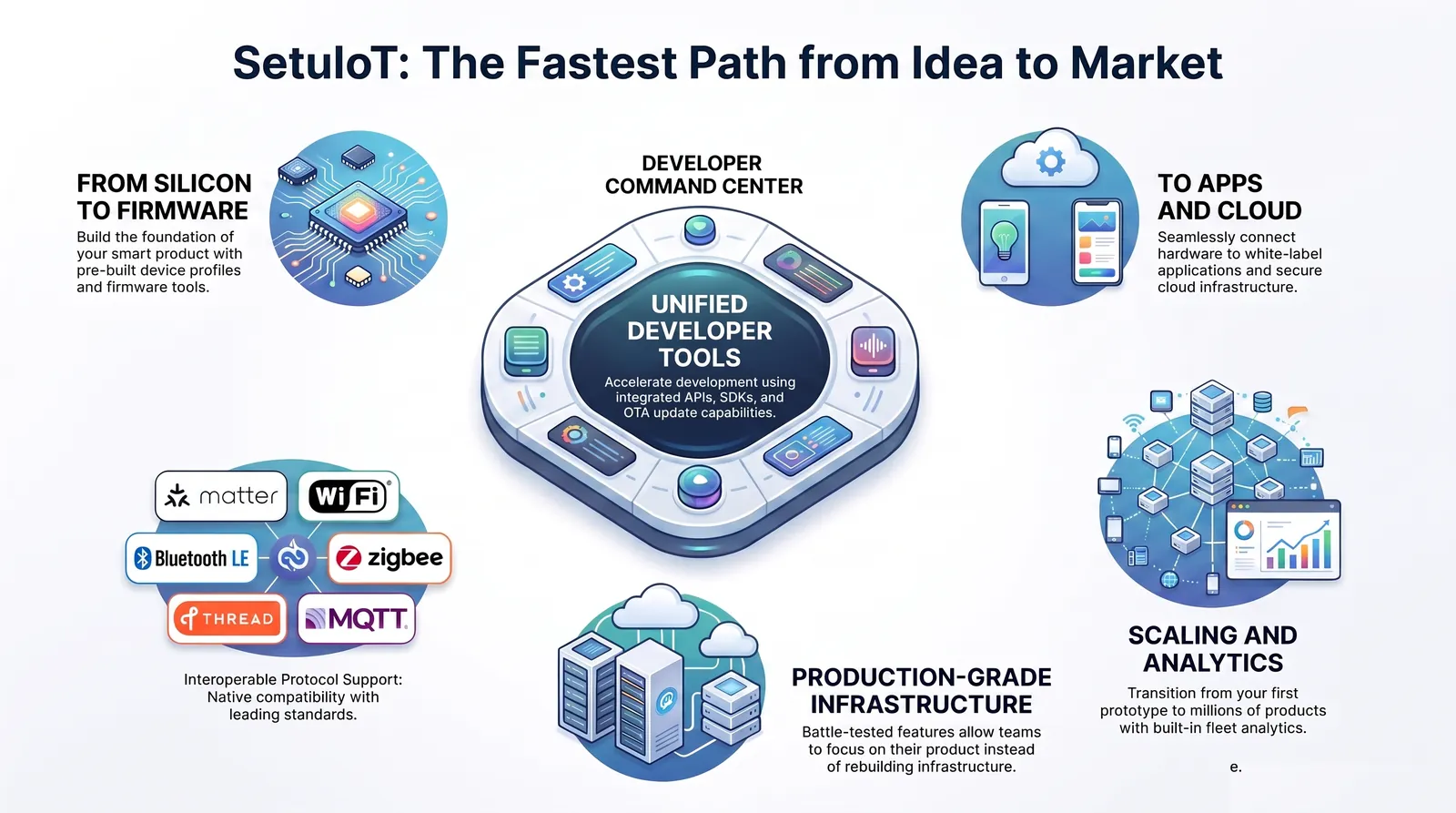
Building a smart, connected hardware product is inherently complex. Historically, companies approaching IoT development assumed that building their device connectivity and cloud backend in-house was the only way to retain full control over their IP and product experience.
However, data shows a starkly different reality: **over 70% of in-house IoT initiatives experience significant budget overruns, launch delays of over 12 months, or fail entirely before reaching production.**
The Hidden Complexity of IoT Infrastructure
Hardware teams excel at hardware design, mechanical engineering, and physical manufacturing. Cloud engineering teams excel at SaaS platforms, database schemas, and front-end user experiences.
The failure point almost always lies in the gap between the two—specifically, in building the secure, robust, and scalable middleware that ties hardware firmware to cloud data endpoints.
When you develop IoT infrastructure in-house, you are committing to build, maintain, and secure:
- Multi-protocol Device Connectivity: Broker engines supporting MQTT, WebSockets, or HTTP protocols with low battery latency.
- Fail-safe OTA Delivery: Safely pushing firmware binaries to fleets without bricking devices in the field.
- Mobile App Frameworks: Bluetooth provisioning, Wi-Fi configuration, and custom control panels for both iOS and Android.
- Security Infrastructure: Mutual TLS certificate rotation, secure boot firmware, and compliance with data localization laws.
"Developing the underlying IoT plumbing takes 80% of the engineering effort but delivers 0% of unique product differentiation. Customers don't buy your smart light switch because of your MQTT broker design; they buy it for features, reliability, and ease of use."
The OEM Platform Approach: Build the Product, Not the Pipes
Leveraging an OEM IoT platform like SetuIoT allows hardware companies to focus 100% of their engineering hours on user-facing features and device firmware customization.
Rather than spending 12 to 18 months assembling brokers, database channels, and iOS/Android pairing sequences, OEMs can utilize turn-key white-label applications and pre-certified SDKs.
Comparison Matrix: In-House vs. SetuIoT
Let's break down the execution phase across typical metrics:
- Development Time: In-house usually takes 12–18 months. With SetuIoT, prototype-to-production shrinks to 4–6 weeks.
- Upfront Capital Expenditure: In-house requires hiring specialized firmware, DevOps, and mobile engineers ($150k+). SetuIoT has virtually zero initial CapEx.
- Scalability Risks: In-house systems often break when scaling from 1,000 to 100,000 active devices due to server tuning. SetuIoT is built on dynamic auto-scaling cloud structures.
Conclusion: Strategic Speed
In connected consumer electronics and industrial devices, speed is the ultimate competitive advantage. Companies that get to market first collect customer feedback, refine firmware, lock down shelf-space, and establish brand presence. By using a secure, pre-built white-label IoT platform, you turn technology risk into a business execution advantage.
Ready to accelerate your connected product launch?
Skip 12 months of development. Talk to our engineering team to integrate SetuIoT with your hardware prototype.